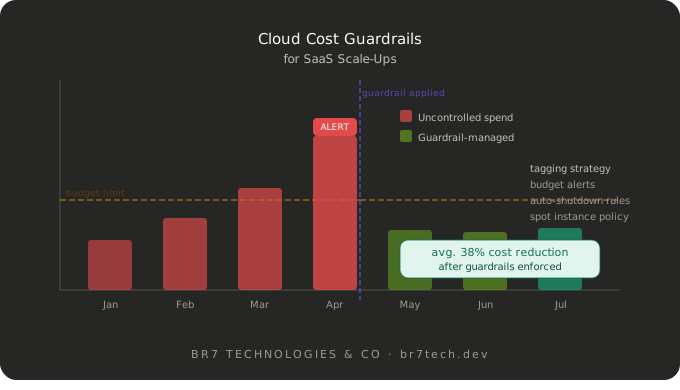
Teams often discover cloud inefficiency only after monthly invoices jump. By then, remediation is harder because overprovisioned patterns are already embedded into release workflows.
We use guardrails that make cost awareness part of delivery instead of an occasional finance exercise.
Budget controls tied to architecture
Cost limits should map to service domains, not one global budget line. This makes ownership clear and helps identify which subsystem is driving spikes.
We set thresholds for compute, storage, and data transfer at service level so teams can act before overruns become structural.
- Service-level budget envelopes
- Alerting based on spend velocity, not only total
- Ownership tags enforced at deployment time
Release governance for spend
Cost impact should be reviewed during architecture and release planning, not after deployment. We include infrastructure diff checks in pull request and release workflows.
This catches risky scaling defaults early, especially for background jobs and data-heavy features.
- PR checks for high-impact infra changes
- Environment-level resource quotas
- Post-release cost snapshots in sprint reviews
Observability that links usage to value
Raw cloud metrics are not enough. We map spend to product usage metrics so teams can evaluate whether increased cost reflects meaningful business growth.
When spend grows without matching value, optimization work is prioritized as product debt rather than optional maintenance.
- Cost-per-active-user and cost-per-transaction metrics
- Workload profiling for idle resource waste
- Quarterly architecture reviews for cost drift
Cost discipline and reliability can coexist. With clear ownership, deployment guardrails, and value-linked observability, scale-ups can keep infrastructure spend predictable while continuing to ship quickly.