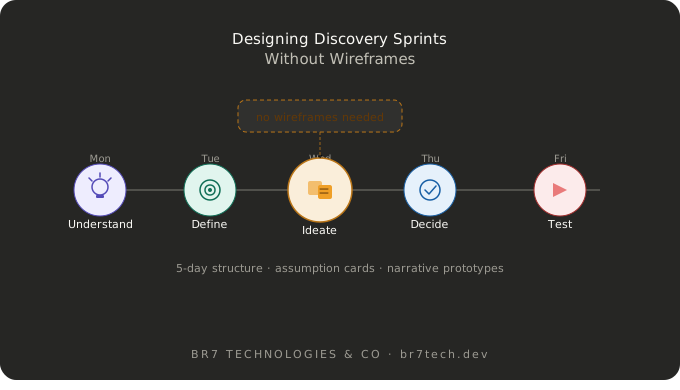
For years, wireframes were treated as mandatory project output. In practice, they often became static artifacts that delayed real decisions and gave teams an illusion of progress.
We replaced wireframes with a tighter discovery system focused on decisions, risks, and interaction behavior. The result was faster alignment and fewer redesign loops during implementation.
Why wireframes failed our projects
Stakeholders interpreted wireframes as near-final screens even when they were intentionally low fidelity. This triggered design debates too early and distracted from core product questions.
Engineering teams also found wireframes insufficient for edge-case handling because key states and transitions were left ambiguous.
- Premature debates about spacing instead of user outcomes
- Weak representation of system states and error behavior
- High rework once real data and constraints appeared
The replacement framework
We now run discovery through three artifacts: decision map, flow prototype, and validation script. Each artifact answers a specific question and has a clear owner.
This keeps every workshop anchored to outcomes instead of aesthetics and gives engineering concrete behavior definitions much earlier.
- Decision map: what must be true for the release to work
- Flow prototype: how users move across critical paths
- Validation script: how we test assumptions quickly
Operational impact on delivery
Projects now enter build phase with better requirement clarity and fewer unresolved dependency questions. Designers and engineers spend less time translating ambiguous artifacts.
The method also improves client communication because each discovery output maps to a business decision rather than a design file milestone.
- Reduced kickoff ambiguity for development sprints
- Higher confidence in scope boundaries
- Faster iteration cycles after first release
Skipping wireframes does not mean skipping thinking. It means replacing low-signal deliverables with decision-focused artifacts that preserve speed and reduce misalignment.