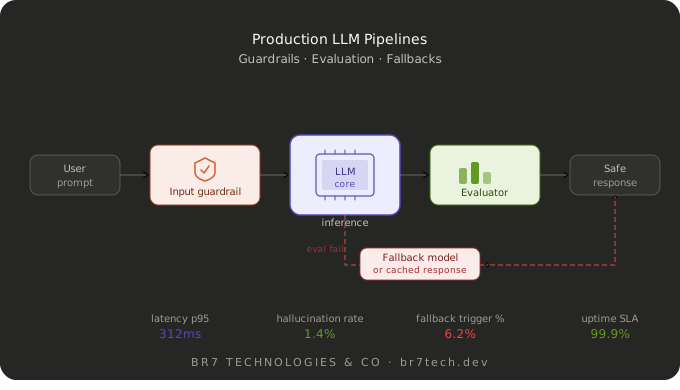
Most AI features fail after launch for predictable reasons: no confidence gating, no fallback behavior, and no quality monitoring once traffic increases. The core model is rarely the real problem.
Reliable LLM products need explicit control planes around generation, retrieval, and post-processing. The model should be one component in an audited system, not the entire system.
Guardrails before model output reaches users
We enforce input checks, context policies, and response validation before any output is returned. This prevents obvious failures and keeps responses within product boundaries.
Confidence thresholds are critical. If confidence falls below the threshold, we route to fallback paths instead of forcing low-quality output into user workflows.
- Schema validation on model inputs and outputs
- Context window and source-quality constraints
- Confidence-aware routing to deterministic fallbacks
Evaluation loops that continue after release
Offline benchmark scores are not enough. We maintain online evaluation datasets sampled from production requests and run regular scoring against relevance, correctness, and safety rules.
Every release includes regression checks on these datasets so model or prompt changes cannot silently degrade quality.
- Representative production-like test sets
- Automated release gates for quality metrics
- Human review queues for low-confidence outputs
Observability and fallback architecture
Monitoring must cover more than latency. We track confidence distribution, fallback rates, invalid output counts, and end-user correction patterns.
Fallback layers include template responses, retrieval-only outputs, and human escalation depending on business criticality.
- Runtime traces for each model step
- Dashboards for confidence and fallback behavior
- Escalation policies for business-critical failures
The difference between AI demos and AI products is operational discipline. When guardrails, evaluation, and fallback design are first-class concerns, LLM features become dependable business tools instead of unstable experiments.